# Breaking Down a Unique Anti-Bot Measure
> While working on automating car searches for DiscoverCars, I stumbled upon a fascinating — and somewhat unusual — security measure designed to verify…
- Author: glizzykingdreko
- Published: 2025-03-21
- Tags: anti-bot, web-scraping, reverse-engineering, web-automation, javascript
- URL: https://takionapi.tech/blog/breaking-down-a-unique-anti-bot-measure
---
While working on automating car searches for **DiscoverCars**, I stumbled upon a fascinating — and somewhat unusual — security measure designed to verify legitimate users. This post details my debugging process, how I identified the key mechanism at play, and why this method is both creative and flawed.
## The Initial Challenge
To retrieve car listings, the system required an **initialization session flow** before making a key request:
```
curl 'https://www.discovercars.com/en/search/get-result-list/{session_id}?gToken={recaptcha_token}' \
-H 'accept: application/json, text/javascript, */*; q=0.01' \
-H 'user-agent: Mozilla/5.0 (Macintosh; Intel Mac OS X 10_15_7) AppleWebKit/537.36 (KHTML, like Gecko) Chrome/134.0.0.0 Safari/537.36' \
-H 'x-requested-with: XMLHttpRequest'
```
After multiple attempts, I encountered **HTTP 400 errors**. Oddly enough, **reCAPTCHA v3 tokens weren’t even validated**. This made me suspect that the real check was happening elsewhere.
## Finding the Real Gatekeeper
I started analyzing cookies one by one and finally identified the critical piece: **gtm_ga_ggbit**. Unlike the other cookies, this one was actively validated. However, online searches turned up almost nothing on it—except for a **one-year-old Freelancer post from a Chinese user struggling with the same issue**.
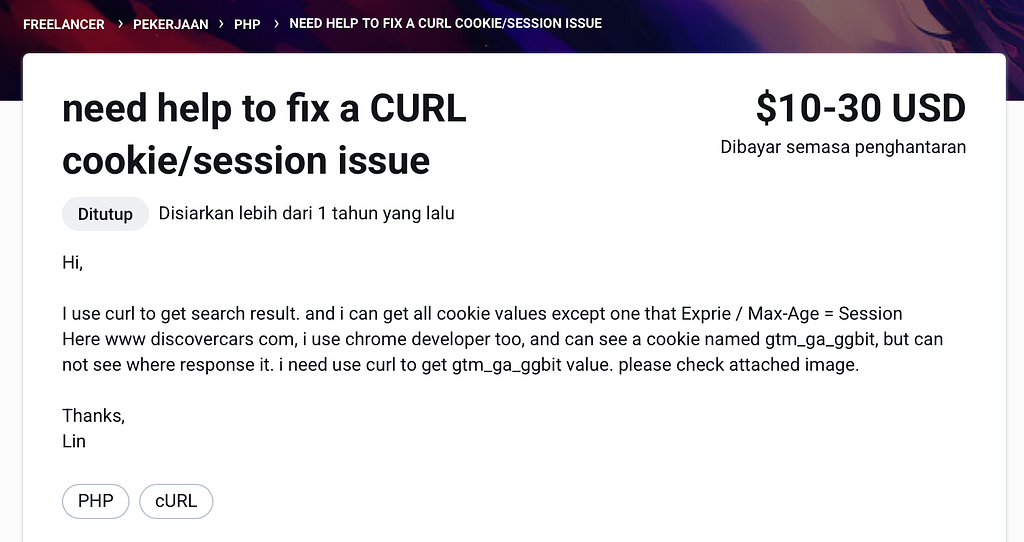
With no documentation available, I shifted to a **debug-first approach** to understand how this cookie was set.
## Tampermonkey Debugging to the Rescue
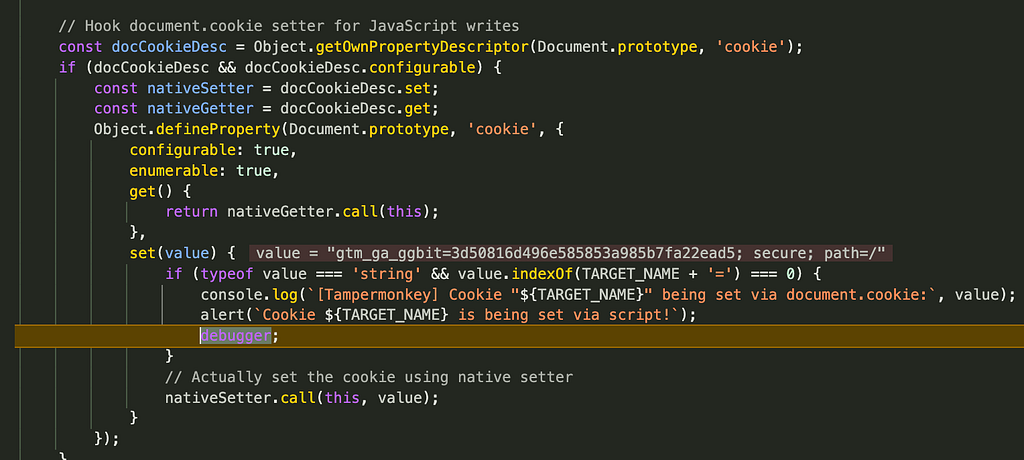
Since I suspected that JavaScript was responsible for generating gtm_ga_ggbit, I wrote a **Tampermonkey script** to hook into document.cookie and break execution when this specific cookie was set.
```
// ==UserScript==
// @name Cookie gtm_ga_ggbit Debugger
// @namespace http://tampermonkey.net/
// @version 1.0
// @description Break into debugger when gtm_ga_ggbit cookie is set by any method.
// @author glizzykingdreko
// @match *://*/*
// @run-at document-start
// @grant none
// ==/UserScript==
(function() {
'use strict';
const TARGET_NAME = 'gtm_ga_ggbit';
let lastCookieValue = document.cookie; // store initial cookies
// Helper: trigger debugger if target cookie present in document.cookie string
function triggerDebuggerIfCookieFound(source) {
// Check for the target cookie name in the cookie string
const cookieStr = document.cookie;
if (cookieStr && cookieStr.indexOf(TARGET_NAME + '=') !== -1) {
console.log(`[Tampermonkey] Cookie "${TARGET_NAME}" detected via ${source}.`);
alert(`Cookie ${TARGET_NAME} was set via ${source}!`);
debugger; // pause execution
}
}
// Periodic check (polling) as fallback for any missed events (e.g., Set-Cookie headers)
function startCookiePolling() {
setInterval(() => {
const current = document.cookie;
if (current !== lastCookieValue) { // cookies changed
if (current.indexOf(TARGET_NAME + '=') !== -1 && lastCookieValue.indexOf(TARGET_NAME + '=') === -1) {
// target cookie appeared (wasn't in last value)
triggerDebuggerIfCookieFound('polling');
}
lastCookieValue = current;
}
}, 500); // check every 500ms (adjust as needed)
}
// Hook document.cookie setter for JavaScript writes
const docCookieDesc = Object.getOwnPropertyDescriptor(Document.prototype, 'cookie');
if (docCookieDesc && docCookieDesc.configurable) {
const nativeSetter = docCookieDesc.set;
const nativeGetter = docCookieDesc.get;
Object.defineProperty(Document.prototype, 'cookie', {
configurable: true,
enumerable: true,
get() {
return nativeGetter.call(this);
},
set(value) {
if (typeof value === 'string' && value.indexOf(TARGET_NAME + '=') === 0) {
console.log(`[Tampermonkey] Cookie "${TARGET_NAME}" being set via document.cookie:`, value);
alert(`Cookie ${TARGET_NAME} is being set via script!`);
debugger;
}
// Actually set the cookie using native setter
nativeSetter.call(this, value);
}
});
}
// Hook Fetch API
if (window.fetch) {
const origFetch = window.fetch;
window.fetch = function(...args) {
return origFetch.apply(this, args).then(response => {
// After response, check cookies
triggerDebuggerIfCookieFound('fetch/XHR response');
return response;
});
};
}
// Hook XMLHttpRequest
if (window.XMLHttpRequest) {
const origOpen = XMLHttpRequest.prototype.open;
XMLHttpRequest.prototype.open = function(...args) {
// (Optional: store URL or method if needed for debugging)
this._debugUrl = args[1];
return origOpen.apply(this, args);
};
const origSend = XMLHttpRequest.prototype.send;
XMLHttpRequest.prototype.send = function(...args) {
this.addEventListener('loadend', () => {
triggerDebuggerIfCookieFound('XHR response');
});
return origSend.apply(this, args);
};
}
// Hook WebSocket
if (window.WebSocket) {
const NativeWebSocket = WebSocket;
// Override WebSocket constructor
window.WebSocket = function(...args) {
const ws = new NativeWebSocket(...args);
ws.addEventListener('open', () => {
triggerDebuggerIfCookieFound('WebSocket handshake');
});
return ws;
};
// Copy prototype to maintain instanceof checks
window.WebSocket.prototype = NativeWebSocket.prototype;
window.WebSocket.CONNECTING = NativeWebSocket.CONNECTING;
window.WebSocket.OPEN = NativeWebSocket.OPEN;
window.WebSocket.CLOSING = NativeWebSocket.CLOSING;
window.WebSocket.CLOSED = NativeWebSocket.CLOSED;
}
// Use CookieStore API events if available (for modern browsers)
if (window.cookieStore && window.cookieStore.addEventListener) {
try {
window.cookieStore.addEventListener('change', event => {
// Check if our target cookie was added/changed
for (const change of event.changed) {
if (change.name === TARGET_NAME) {
console.log(`[Tampermonkey] Cookie "${TARGET_NAME}" change detected via CookieStore API.`);
alert(`Cookie ${TARGET_NAME} was set (CookieStore API)!`);
debugger;
}
}
});
} catch(e) {
console.warn('CookieStore API event registration failed:', e);
}
} else {
// Fallback to polling if CookieStore events not supported
startCookiePolling();
}
})();
```
With this script, I could pinpoint exactly where gtm_ga_ggbit was being set.
## Uncovering the SVG-Based Obfuscation
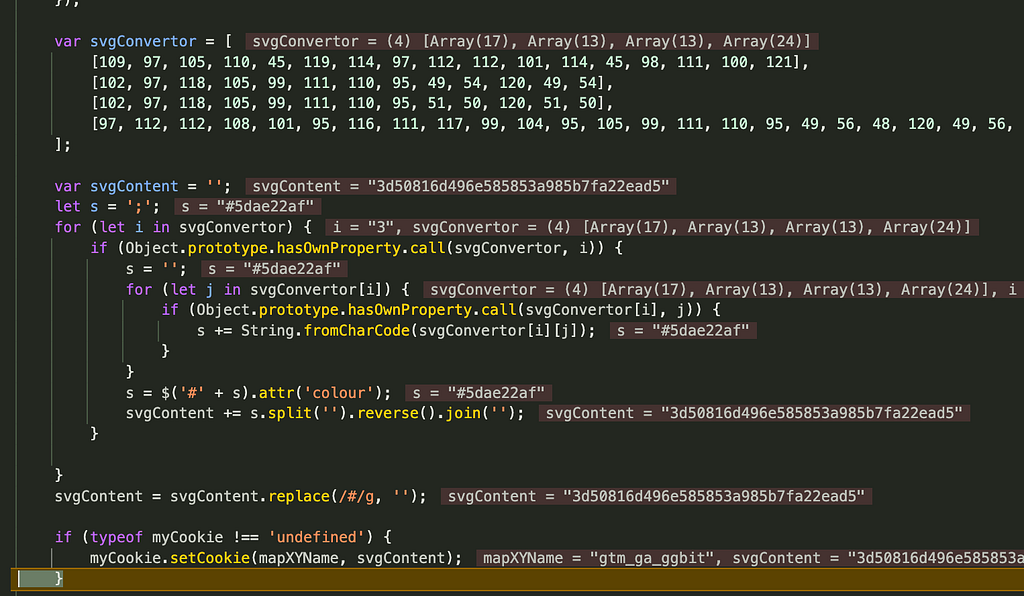
The key revelation came from observing a strange JavaScript function that generated gtm_ga_ggbit using **color attributes from SVG elements** embedded in the frontend.
### JavaScript Logic
```
var svgConvertor = [
[109, 97, 105, 110, 45, 119, 114, 97, 112, 112, 101, 114, 45, 98, 111, 100, 121],
[102, 97, 118, 105, 99, 111, 110, 95, 49, 54, 120, 49, 54],
[102, 97, 118, 105, 99, 111, 110, 95, 51, 50, 120, 51, 50],
[97, 112, 112, 108, 101, 95, 116, 111, 117, 99, 104, 95, 105, 99, 111, 110, 95, 49, 56, 48, 120, 49, 56, 48]
];
var svgContent = '';
for (let i in svgConvertor) {
let s = '';
for (let j in svgConvertor[i]) {
s += String.fromCharCode(svgConvertor[i][j]);
}
s = $('#' + s).attr('colour');
svgContent += s.split('').reverse().join('');
}
if (typeof myCookie !== 'undefined') {
myCookie.setCookie('gtm_ga_ggbit', svgContent);
}
```
### Breaking It Down
- The svgConvertor array deciphers into **the IDs of four frontend elements**: main-wrapper-body, favicon_16x16, favicon_32x32, apple_touch_icon_180x180
- Each of these elements has a colour attribute containing **a seemingly random hex string**.
- The script **extracts these values, reverses them, concatenates them, and assigns them to ****gtm_ga_ggbit**.
Example:
```
```
This approach is **unique** because it dynamically obfuscates the cookie value based on frontend-rendered elements, likely making it harder for automated tools to predict.
## Bypassing It in Python
Despite its creativity, this method is easy to reverse-engineer. We can simply **parse the frontend**, extract the necessary values, and reconstruct the cookie.
```
soup = BeautifulSoup(frontend_response.text, 'html.parser')
svg_content = ''
for element in [
"main-wrapper-body",
"favicon_16x16",
"favicon_32x32",
"apple_touch_icon_180x180"
]:
data = soup.find(id=element).get('colour')
svg_content += ''.join(reversed(data))
svg_content = svg_content.replace('#', '')
session.cookies.set("gtm_ga_ggbit", svg_content)
```
## Final Thoughts
This was one of the **most creative anti-bot techniques** I’ve encountered. While it’s a clever way to obfuscate authentication, it’s ultimately ineffective because:
1. **The values are client-side** and can be extracted effortlessly.
2. **The logic is predictable** once analyzed.
3. **It adds complexity without significantly improving security.**
Nonetheless, this approach could trick **less experienced devs** into wasting time debugging other factors, making it an amusing case study in security-through-obscurity.
Would love to hear if anyone else has encountered similar techniques!
## Follow & Contact Me
If you enjoyed this breakdown, feel free to follow me on:
- **GitHub**: [glizzykingdreko](https://github.com/glizzykingdreko)
- **Medium**: [glizzykingdreko](https://medium.com/@glizzykingdreko)
Or reach out directly:
- **Discord**: glizzykingdreko
- **Email**: glizzykingdreko@protonmail.com